Research · WP—02 All research →
When the Message Meets the Moment: State-Dependent Effects of Monetary Policy Surprises on the Term Structure of Inflation Expectations
Abstract
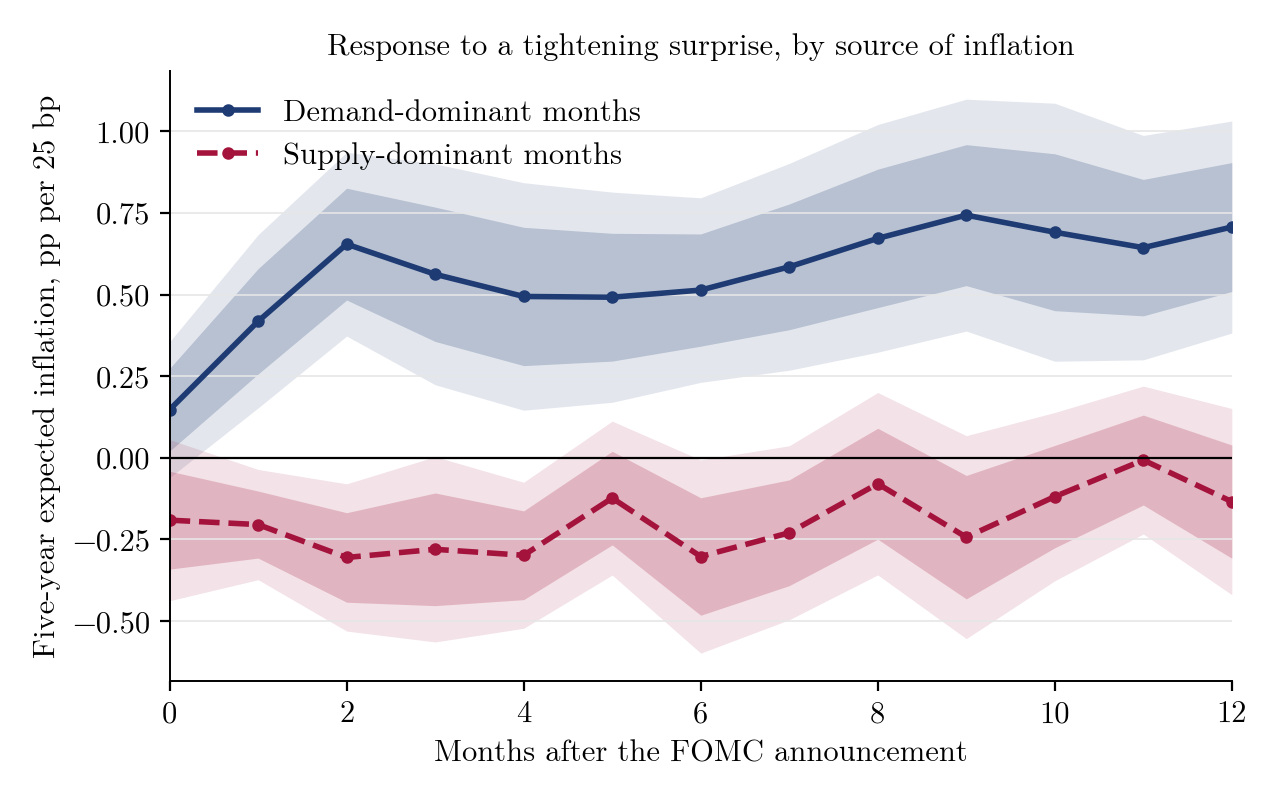
How an FOMC announcement moves inflation expectations depends on what is driving inflation when it arrives, and on whose expectations are measured. I estimate state-dependent local projections of the Jarociński–Karadi monetary policy and information shocks on the Cleveland Fed expected-inflation term structure, on nominal and TIPS yields and breakevens, and on the Michigan and professional-forecaster surveys, conditioning on Shapiro's decomposition of core PCE inflation into demand- and supply-driven contributions, over 1990 to 2025. Averaged across states a policy surprise leaves every measure unchanged. Conditioned on the state, a 25 basis point tightening raises the model-based five-year expectation by two thirds of a percentage point when demand factors dominate and lowers it by a third when supply factors dominate, and moves nominal and real yields the same way, more strongly, and already in the pre-TIPS decade. But breakevens show the pattern only on impact, professional forecasters do not revise inflation forecasts after policy surprises, and households lower their one-year expectations a year after a tightening delivered during supply-driven inflation and not otherwise. The model's demand-regime rise is a decomposition of a yield movement, not a change in beliefs. Information shocks raise every measure that responds, and more so when demand is the story.
Presentations
Columbia Undergraduate Research Symposium (Oct 2025)
Cite
@unpublished{Sotomayor2026MessageMoment,
  author = {Sotomayor, Tyler},
  title  = {When the Message Meets the Moment: State-Dependent Effects of Monetary Policy Surprises on the Term Structure of Inflation Expectations},
  note   = {Working paper, Columbia University},
  year   = {2026}
}