Research

Working papers

Drafts and slides are linked where available. For anything not yet posted, email me.

01

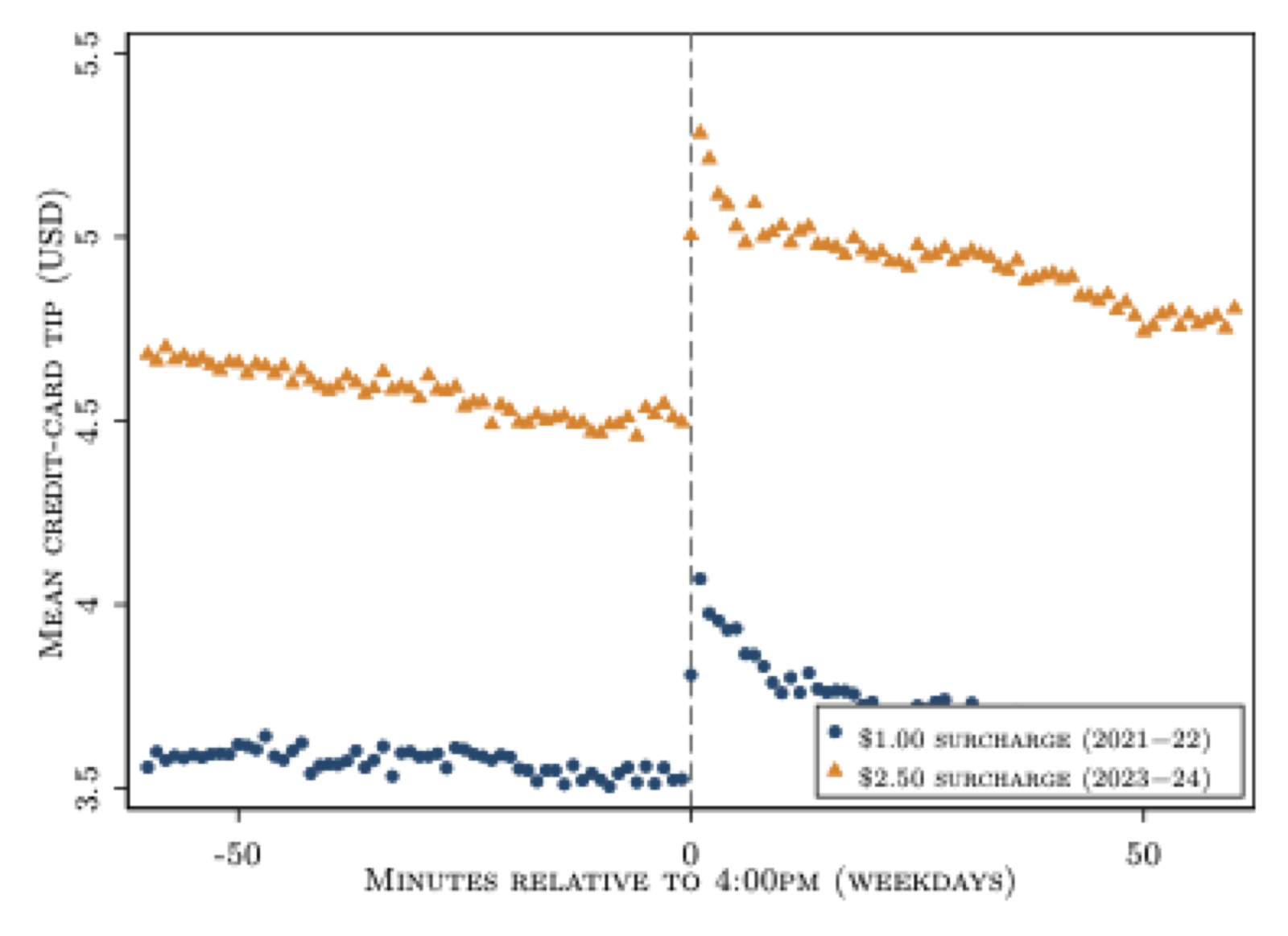
Tipping the Tax: How Government Surcharges Become Gratuities

with Gabriel Uceda-Sosa

Suggested-tip screens compute percentages of the fee-inclusive total, so eleven cents of every legislated surcharge dollar on New York taxi meters becomes tip.

Abstract
New York taxi screens suggest tips as percentages of the fee-inclusive total, so every government surcharge on the meter raises every suggested tip. We estimate the causal pass-through of statutory charges into gratuities: eleven cents of each legislated surcharge dollar becomes tip, about four-fifths of the rate at which riders tip the fare itself. Identification comes from six sources of quasi-experimental variation: surcharges that switch on and off at fixed clock times, the holiday calendar, a large repricing, a flat fare, and the spatial boundary of the 2025 congestion toll. The per-dollar estimate is stable across doses from $0.50 to $5.00 and in both directions, and riders absorb the charges rather than re-optimize. At the 2025 schedule, $141 million of government charges flow through the tip base each year, generating $15–21 million in gratuities that no legislature enacted; ignoring tips misstates the incidence of these charges.

Presented at PREDOC Summer Research Conference, Chicago Booth (Jul 2026)
Working paper PDF ReplicationInteractive PosterSlidesBibTeX

02

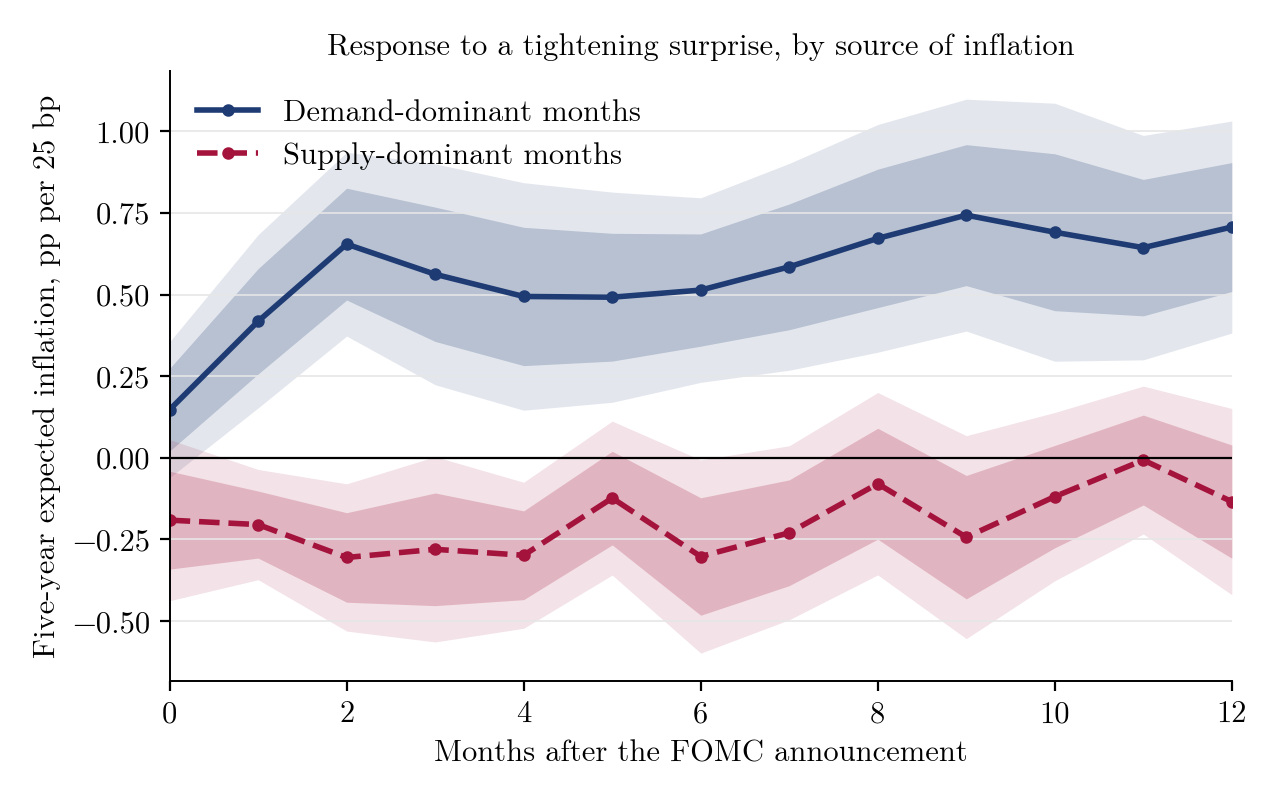
When the Message Meets the Moment: State-Dependent Effects of Monetary Policy Surprises on the Term Structure of Inflation Expectations

How monetary policy announcements move household inflation expectations across horizons; effects are strongest during supply-driven inflation.

Abstract
Anchoring inflation expectations is central to effective monetary policy, yet relatively little empirical work explores how the term structure of expectations responds to different types of monetary surprises across inflationary regimes. Building on the identification strategy of Jarociński and Karadi (2020), which separates monetary policy surprises into pure rate shocks and central bank information shocks, I examine how each type of shock affects the term structure of survey-based inflation expectations (1–30 years) using a state-dependent local projection framework that incorporates Shapiro's (2024) decomposition of inflation into supply- and demand-driven components. While conventional monetary policy shocks predominantly influence short- and medium-term expectations, central bank information shocks exhibit broader and more persistent effects across the entire horizon — and supply-driven inflation regimes amplify the response of expectations, whereas demand-driven regimes attenuate them. The findings suggest that the effectiveness of monetary policy, particularly forward guidance, depends not only on the nature of the policy innovation but also on the underlying sources of inflation.

Presented at World Bank PREDOC Summer Research Conference (Aug 2025) · Columbia Undergraduate Research Symposium (Oct 2025)

Working paper

03

Merit Aid, Sorting, and Institutional Access: Evidence from Tennessee's HOPE Scholarship

with Balint Kidd, Tommy Soltanian, Gabriel Uceda-Sosa

After Tennessee's 2004 HOPE Scholarship, the bottom-quintile share at public colleges rose 1.5 percentage points — merit aid that expanded access rather than concentrating it.

Abstract
Merit-based scholarships are typically found to be regressive because academic eligibility correlates with family income. Using tax-linked data from Chetty et al. (2020), we document an exception. Following the 2004 introduction of Tennessee's HOPE Scholarship, the bottom-quintile share at Tennessee public colleges rose by 1.50 percentage points relative to non-merit control states, with a monotonic gradient across all five income quintiles. Total enrollment at Tennessee publics expanded by roughly seven percent, indicating that the compositional shift reflects system expansion rather than displacement of higher-income students. The effect concentrates at community colleges and is larger for female students, consistent with HOPE's permissive eligibility threshold (GPA 3.0 or ACT 21) binding most tightly at the marginal-eligibility margin. Cross-state evidence supports a design-based interpretation: Massachusetts (progressive) and South Dakota (regressive) produce compositional shifts in directions predicted by their threshold strictness and award structure. The Tennessee result is robust to unit-specific detrending, to Rambachan–Roth sensitivity at breakdown values above M* = 2, and to a triple-difference specification that differences out Tennessee-wide trends. Program design — threshold strictness, first-dollar status, and capacity response — predicts whether merit aid expands access or concentrates it.

Presented at Economic Scholars Program, Federal Reserve Bank of Cleveland (2026)

Working paper PDF SlidesBibTeX

04

Belief Distortions and Endogenous Wage Rigidity in a Search Economy

Household surveys reverse the Phillips-curve sign — consumers expecting higher unemployment also expect higher inflation; a search-and-matching model with rational inattention turns this belief distortion into endogenous wage rigidity.

Abstract
Household survey data contain a robust reversal of the Phillips-curve sign: consumers who expect higher unemployment also expect higher inflation, while professional forecasts and post-1980s U.S. data display the conventional negative relationship. Respondents in the Survey of Consumer Expectations who simultaneously expect higher inflation and higher unemployment also report higher personal job-loss risk, suggesting the distortion extends to perceived labor-market conditions. I embed this fact in a New Keynesian search-and-matching model with rational inattention, where workers with limited information capacity choose what to pay attention to. Supply-side risks receive more attention because they are costly on every margin; demand-driven improvements in the labor market are tracked less closely because higher prices partly offset a tighter job market. When a demand expansion improves workers' bargaining position, inattentive workers do not fully perceive the improvement and accept wages that are too low. The resulting wage rigidity is endogenous rather than imposed. At the quarterly structural calibration, the wage distortion after demand shocks is five times larger than after supply shocks, and this asymmetry is robust to the flow value of unemployment, supply-shock persistence, and the wage-belief elasticity.

Presented at PIER Conference, Williams College (2026)

Working paper Preview BibTeX

Papers by field
Paper
WP—01
WP—02
WP—03
WP—04
WP—05
WP—06

Select a field to filter the list above.